On location – the Nile

There are many wonderful places to visit along the Nile.  The standard Nile cruise itineraries take visitors to the sites on both banks of the Nile at Luxor, then head south towards Aswan.

I’ve put together a short video showing my favourites on the journey between Luxor and Aswan: Efdu, Kom Ombo, Philae – all of which date from the Greaco-Roman period.  Also the Unfinished Obelisk still lying in its granite quarry in Aswan where Queen-Pharaoh Hatshepsut’s workmen were forced to leave it when a huge crack appeared in the rock.  If it had been finished it would have stood one third taller than any other obelisk in Egypt.  And, of course, the magnificent Abu Simbel on Lake Nasser.  This is a feat of both ancient and modern engineering.  UNESCO re-sited it in the 1960s to rescue it from the rising waters of Lake Nasser.  Most cruises give the option to either drive or fly down to see it – and it’s not to be missed – despite the early start!

Merry and Adam go on a Nile cruise in the third book in my series following Meredith Pink’s Adventures in Egypt – Hatshepsut’s Hideaway.  They visit Edfu and Kom Ombo – with incidents in both of course!  It wouldn’t be a story otherwise!

If you’re interested in seeing a similar video on the sites of Luxor, check out my link: On Location in Luxor.

Fiona Deal
On location in Luxor

Luxor in Egypt provides the setting for my books following Meredith Pink’s Adventures in Egypt.  I’ve stayed many times in Luxor.  It’s a kind of open air museum.  All the key sites are within easy travelling distance, on either the East Bank (where most of the modern hotels are located) or the West Bank of the Nile.

Some of those who’ve been kind enough to write reviews of my books – and have obviously travelled to Egypt themselves – have said the books bring back great memories for them.  Egypt really is a place once visited, never forgotten.

For those of you who may not have been lucky enough (yet ?!) to travel to the magical land of the pharaohs, here’s a short video I put together.  It’s my take on some of the most impressive historical sites Luxor has to offer.

I haven’t yet used all these archaeological sites as settings for scenes in my books.  And there are a few locations I haven’t included in this video.  The Ramesseum for one, and the Temple of Seti I – both located on the West Bank.

That’s the whole thing about Egypt … there’s so much to see … so much history.  It’s hard to know what to include and what to leave for another time …

And it keeps drawing me back.

Fiona Deal

What sparked my enduring fascination with Egypt?


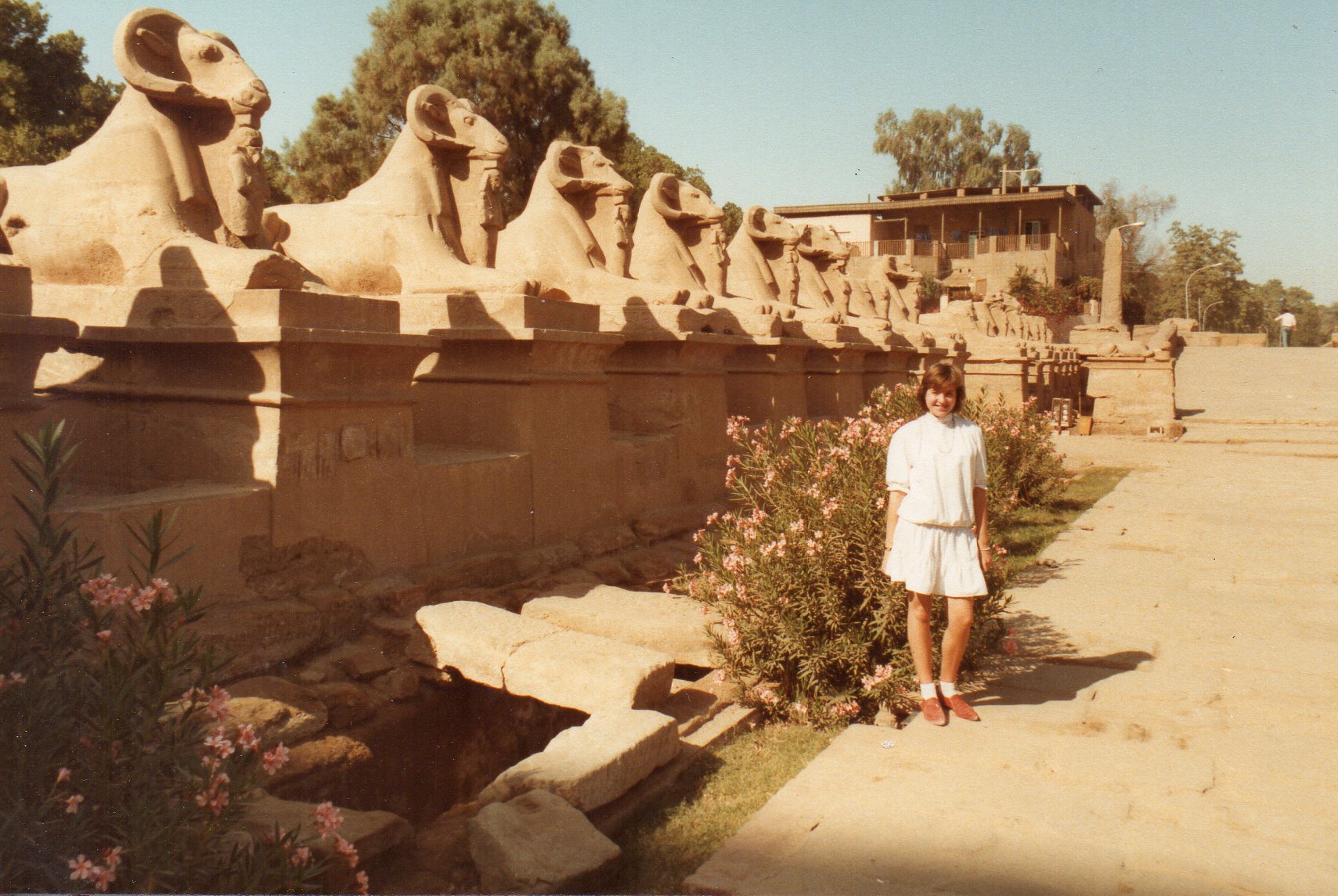
img230Ok, so here I am aged 16  with the ram-headed sphinxes at Karnak.  It’s October 1983.  I’m on my half-term break.  I’m in Egypt with my parents and younger brother, on the cheap, courtesy of my dad working for an airline and qualifying for concessionary travel.

Cute red pixie shoes, huh?  It took me almost thirty years to actually start writing adventure stories about the land of the pharaohs.  Yet the fascination was sparked back then.  Why?

Perhaps something in the light quality?  It’s a soft pink in Egypt – you can kind of see it in the sky in the photo as it fades to the distance.  I think this has something to do with the quantities of sand and dust in the atmosphere, and so little rain.  Whatever, it makes for some of the most spectacular sunsets on earth.  And a filmy haze over everything that’s like looking at everything in soft-focus.  There’s something very romantic about light quality I think.

Then there’s the immense SCALE of everything.  Standing on the giza plateau and craning up at the great pyramid.  Likewise in Karnak, dwarfed by the columns in the Hypostyle Hall.  How did they do it without modern equipment and engineering?  Was it spacemen?  As a teenager, this was an intriguing thought!

And, of course, the history.  Stepping into the thick, stifling atmosphere of a centuries-old tomb that looks as if the artisans laid down their paint-pots just yesterday.  Learning from the guide that they got light into the depths of their ancient sepulchres while they were carving and decorating them by reflecting the sun from great sheets of electrum at the tomb entrance.  True?  Possibly – not sure if it was really electrum !  But the guides demonstrated it ably enough with a metal biscuit tin.

Standing inside Tutankhamun’s tomb … gawping at the sarcophagus that still contained the remains of the boy king …  Trying unsuccessfully to grapple with the unimaginable period of time – thirty-or-so centuries – that he’d been there.

Or perhaps it was the weird and wonderful stories about the pharaohs and their queens themselves.  Did Ramses II REALLY have more than two hundred children, some by his own daughters?  It was a thought to make me squirm – standing alongside my own father listening to the guide.  Were brothers and sisters REALLY married to each other?  I remember looking at my fourteen year old brother and thinking ‘ugh’.

So somehow, it’s all larger than life, a little bit Hollywood, and desperately mysterious and intriguing.  Nowhere like it on earth !  It reached out and grabbed me.  More than thirty years later it shows no sign of letting go.