Belzoni’s Bequest

belzonis-bequest-fiona-dealHere’s the new book cover for my latest novel in the Meredith Pink series, now available on Amazon.

Click here to learn more or to buy now.

Swapping the heat and dust of Egypt for the cooler climes of London, Merry and Adam find themselves caught up in an intrigue involving the Egyptian collection at the exalted British Museum.

First of all, an Egyptologist disappears in the midst of a security evacuation. Then Merry stumbles across a mystery suggesting the circus strongman Giovanni Belzoni and his wife discovered more than just tombs and temples during their excavations in the early 1800s.

A stolen journal, a set of newspaper-wrapped artefacts, and a blast from Adam’s past combine to make this a most perplexing mystery!

I hope you enjoy it. As ever, I welcome feedback and comments. I also read and appreciate all reviews on Amazon.

Fiona Deal, October 2016

Belzoni’s Bequest now published

BookCoverImageBook number 7 in the series following Meredith Pink’s adventures in Egypt is now published on Amazon.  For a limited period it will be available with the old-style cover design.  This is to enable anyone who was collecting the series before I updated the covers to have the new book in the same style as the others if they wish.  The new cover will replace this one at end-September.

Belzoni’s Bequest

Swapping the heat and dust of Egypt for the cooler climes of London, Merry and Adam find themselves caught up in an intrigue involving the Egyptian collection at the exalted British Museum.  

First of all, an Egyptologist disappears in the midst of a security evacuation.  Then Merry stumbles across a mystery suggesting the circus strongman Giovanni Belzoni and his wife discovered more than just tombs and temples during their excavations in Egypt in the early 1800s.  A stolen journal, a set of newspaper-wrapped artefacts, and a blast from Adam’s past combine to make this a most perplexing mystery!

As ever, I welcome feedback and comments here on my website.  I also read and very much appreciate all reviews on Amazon.

To find out more or download now please click here.  The book is also available in paperback.

I hope you enjoy Merry’s latest adventure … Fiona


Refresh and Relaunch

“Fiona, your books are great fun to read … but your cover designs are doing you no favours.”  So I was told recently.  “Why don’t you update the jackets so they look like the fictional adventure stories they are?  At the moment they look like dull and boring history books!”

I’ve always believed it’s a good thing to respond positively to feedback.  So, here are the results.  I’ll let you judge for yourselves …

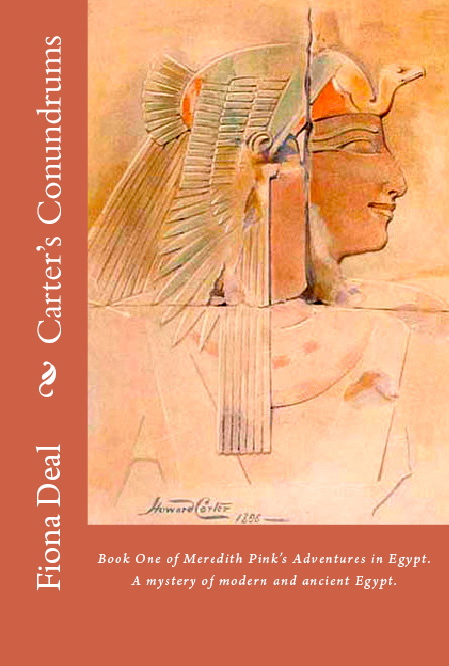
In my first book, Merry gets trapped in the Howard Carter Museum in Luxor, and finds some hidden hieroglyphics.  It sets her off on a madcap treasure hunt…

From this …       BookCoverPreview.do            To this … IDBC00078 Meredith Pink’s Adventures in Egypt - Fiona Deal - CC

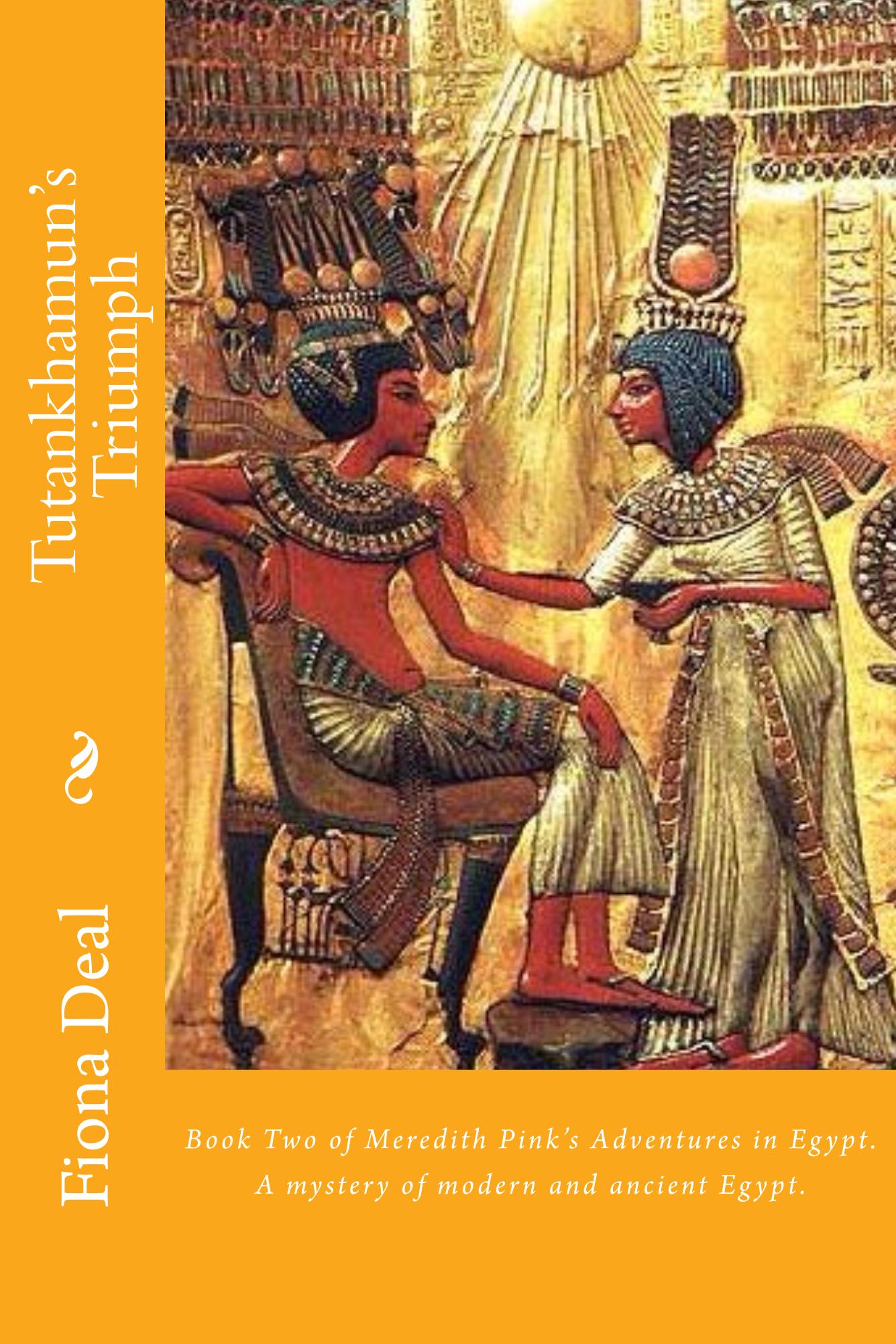
In Merry’s second adventure, the hieroglyphics have led her to believe there may be precious jewels hidden in Egypt … If only she can find them before anyone else does …

From this …        BookCoverPreview.do             To this … IDBC00078 Meredith Pink’s Adventures in Egypt - Fiona Deal - TT

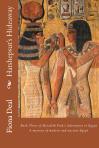
In book 3, Merry has found the precious jewels … but can she protect them …?

From this …       Hatshepsut's_Hideawa_Cover_for_Kindle              To this … IDBC00078 Meredith Pink’s Adventures in Egypt - Fiona Deal - HH

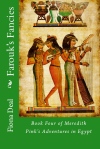
Her fourth adventure finds Merry racing to find a Dead Sea Scroll, perhaps hidden by King Farouk before it can fall into the wrong hands …

From this …        BookCoverPreview.do            To this …  IDBC00078 Meredith Pink’s Adventures in Egypt - Fiona Deal - FF

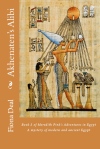
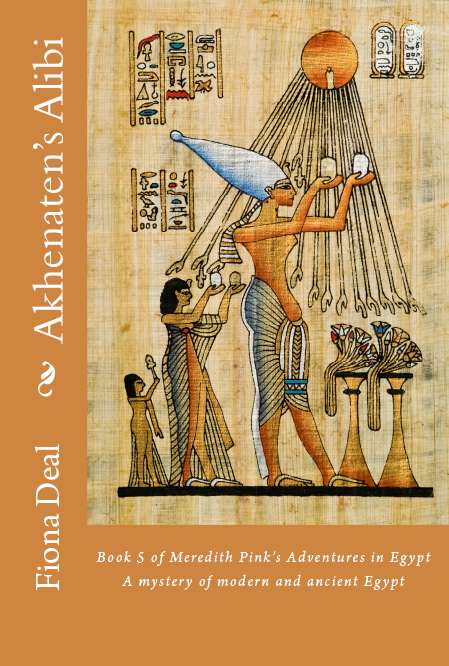
In book 5, Merry is trying to stay one step ahead of a blackmailer intent on exposing her explosive secrets …

From this …        BookCoverPreview.do            To this …  IDBC00078 Meredith Pink’s Adventures in Egypt - Fiona Deal - AA

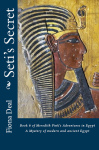
And her most recent adventure finds Merry on a quest to discover the inside track on “The Greatest Story Ever Told” – The Exodus …

From this …      BookCoverPreview.do            To this … IDBC00078 Meredith Pink’s Adventures in Egypt - Fiona Deal - SS

Hmm, I can completely see where the person was coming from …

Personally, I love them.  I hope you do, too.

Fiona Deal


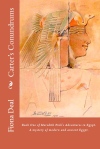
Carter’s Conundrums

BookCoverPreview.doCarter’s Conundrums is the first book in my fictional series following Meredith Pink’s Adventures in Egypt.  It’s available  to download at the special promotional price of £0.99/ $1.50 here.

The books are present-day adventure stories.  Meredith (Merry) is a thoroughly modern heroine who gets caught up in ancient Egyptian mysteries.  No time travel, but in Carter’s Conundrums she embarks on a treasure hunt.

When English tourist Meredith Pink finds herself locked inadvertently in the Howard Carter museum in Luxor for the night, she has no idea about the thrilling Egyptian adventure she’s about to embark on.  The museum was once Howard Carter’s home, where he lived during the historic years of his discovery and clearance of Tutankhamun’s tomb in the Valley of the Kings.  Attempting to break free, Merry accidentally smashes the frame surrounding an original Carter watercolour of an elusive Egyptian queen.  The discovery inside of a hidden message from Howard Carter himself, together with a set of mysterious hieroglyphics, sets her off on a quest to solve the puzzle of a lifetime. 

Along the way she teams up with the dashing Adam Tennyson, a self-proclaimed “thwarted” Egyptologist.  Together they set about unriddling the ancient texts, and find themselves on a madcap treasure hunt around some of Egypt’s most thrilling locations.  

An exciting blend of adventure, mystery and romance, Carter’s Conundrums will demand all of Merry’s imagination and love of the fabled ancient land of the pharaohs to keep her on the trail, and out of trouble.

Read the reviews here.

Fiona Deal – author of Meredith Pink’s Adventures in Egypt

BookCoverPreview.doBookCoverPreview.doHatshepsut's_Hideawa_Cover_for_KindleBookCoverPreview.doBookCoverPreview.doBookCoverPreview.do

The incredible length of Egypt’s civilisation

The link below will take you to an article showing 23 “mind-blowing facts that will destroy your understanding of time”.  The author requests shares, so I’m doing just that.

Two of the facts relate to ancient Egypt and help to demonstrate just what an incredibly long passage of time the Egyptian civilisation can claim.

UnknownFirst, Cleopatra lived closer in time to the building of Pizza Hut than the building of the Great Pyramid of Giza.

Cleopatra ruled as the last Pharaoh at around 30BC, before Egypt fell to the Roman Empire.  The Great Pyramid was already approximately 2,500 years old, having been built for the pharaoh Khufu in the Old Kingdom of dynastic Egypt in circa 2560 BC.

UnknownThe first Pizza Hut opened in 1958, approximately 500 years closer in time to Cleopatra than Khufu’s pyramid.

I can’t help but wonder if Cleopatra’s knowledge and understanding of the reign of her Old Kingdom predecessor was much as ours is of her: coloured by myth and legend, and the passage of thousands of years.

Broadly contemporary with Cleopatra was the first century Romano-Jewish scholar and writer Josephus. As far as we know his work contains the only reference to the earlier Egyptian historian and priest, Manetho, who wrote his fabled Aegyptiaca some 300 years before Cleopatra ascended to the throne.  It gave a history and chronology of the pharaohs.  Whether it shed any more light on the historical facts of the dynasties that pre-dated Cleopatra’s Ptolomaic ancestry than Shakespeare did on Cleopatra’s own story is a matter for debate.

tm9The other fascinating fact is that the first pyramids were built while the woolly mammoth still roamed the earth.  A small population of mammoths survived until circa 1650 BC, by which time Egypt’s empire was well established, and the pyramids were already about a thousand years old.

I’s bind-bending stuff : how the Egyptian civilisation spans what we might consider almost prehistory, right up to the Roman Empire whose influence can still be felt in Britain today.

Perhaps this explains why ancient Egypt is such a rich source of inspiration for writers of fiction such as myself.  With a history spanning something like three thousand years, with so many famous names, and with so much gold, how can we help but be fascinated by its mystery and romance?  And with the inevitable gaps in our historical knowledge after such an immense passage of time, how tempting it is to try to fill in the blanks.

That’s what my fictional series following Meredith Pink’s Adventures in Egypt aims to do.  In each story, I take an ancient mystery and weave a story around it, letting my imagination put the flesh on the bones of what we know from archaeology and historical research.

Here is the source article, which got me thinking about Egypt’s incredibly long history : http://higherperspective.com/2015/02/understanding-time.html?utm_source=cleo&ts_pid=2

Fiona Deal – author of Meredith Pink’s Adventures in Egypt, available in paperback or to download from Amazon and all major ebook retailers.

BookCoverPreview.doBookCoverPreview.doHatshepsut's_Hideawa_Cover_for_KindleBookCoverPreview.doBookCoverPreview.doBookCoverPreview.do

A Cook Abroad: in Egypt

Photo credit : BBC

Photo credit : BBC

At last ! A programme about Egypt to warm the heart – whet the appetite –  and hopefully encourage tourists to return.  On Monday evening BBC2 screened the first of six episodes in a new series called ‘A Cook Abroad’.

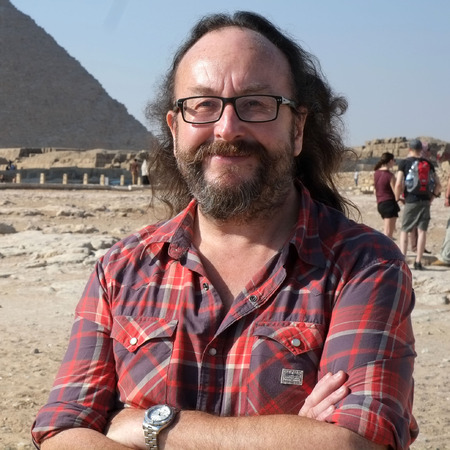
First up TV chef and one half of the Hairy Bikers travelled to Egypt to experience the nation’s culinary offerings, and explore a bit of its history.

Travelling from Cairo to Luxor via Fayoum by motorbike, and then on to Aswan aboard the steamship Sudan (the inspiration for Agatha Christie’s Death on the Nile), Myers took time to visit many of the country’s historical sites along the way.

After sampling street food for breakfast in Cairo – a bean dish called ‘ful medames’ – Myers headed out to the pyramids at Giza to fulfil his boyhood dream of standing in their shadow.

But it was his trip to the ancient necropolis of Saqqara that really got him excited.  There, he enthused over the tomb wall paintings dating back more than 4,500 years depicting the baking of bread.  As Myers pointed out, this must surely count as the earliest recipe on record!

In the oasis of El Fayoum Myers enjoyed dates pulled freshly from the palm tree, then attempted (with little success but much hilarity) to emulate the skill of the fellahin’s wife in tossing her homemade bread atop an oven-dish that looked like a pizza pan, the idea being to make flat bread of pancake-like proportions.

In Luxor, Myers sampled a delicious-looking stuffed pigeon in a local restaurant before dressing up to board the steamship Sudan, where the chef taught him to make a local delicacy called um ali (a sweetened bread and butter pudding with hot milk).  But first, he visited the West Bank where he sampled shasmi bread with a local called Mahmoud.  He noted how the design Mahmoud’s wife baked into her bread was the same as on the loaves depicted in the ancient wall paintings in Deir el Medina, the Village of the Workers.  Great to see that some things haven’t been lost down the centuries.

To mark the end of his journey, Myers was invited by a family of Nubians for a feast to celebrate the end of Eid Al Adha, and help prepare a traditional meal to be shared with family, friends and neighbours.

For Myers, the star of the show was the home-baked Egyptian bread, in all its various forms.  For me, it was seeing the warm welcome he was given by all the Egyptian people he encountered.

All in all, it was a programme that left me longing to return.  I was even nostalgic for the haggling game, watching Myers enter some good-natured bartering with trinket sellers near the Colossi of Memnon.  I can only hope others watching the programme had their appetites similarly whetted.  Well done Dave Myers on showing us the delightful side of Egypt and its people.

Since Egyptian food in singularly absent from what’s on offer in the UK – as Myers pointed out,  “Where can you go for an ‘Egyptian’?” – the best bet is surely to visit the Land of the Pharaohs and sample it with the locals.

Fiona Deal – author of Meredith Pink’s Adventures in Egypt – available in paperback on Amazon or to download from Amazon or all major ebook sellers.

BookCoverPreview.doBookCoverPreview.doHatshepsut's_Hideawa_Cover_for_KindleBookCoverPreview.doBookCoverPreview.doBookCoverPreview.do

Tutankhamun’s Death Mask damaged

ekwva5v7srjibrfg1skwIt just goes to show … fact can sometimes be stranger than fiction !  Yesterday, 22 January 2015, the story hit the world’s headlines that the famous death mask of Tutankhamun, on display at the Egyptian Antiquities Museum in Cairo, was allegedly damaged last year.  The blue plaited beard was apparently knocked off.  A botched repair job appears to have been undertaken to glue it back on with epoxy, leaving a discernible line of glue.  To make matters worse, it’s reported that attempts to scratch off the visible glue inflicted more damage.  There are conflicting reports about whether the damage was purely accidental, or whether the – detachable – beard was knocked off during cleaning.

A committee has now been set up to investigate exactly what happened.

Whatever the truth or real circumstances of what happened, this story raises all sorts of questions about the protection, care and preservation of Egypt’s ancient artefacts in the years since the revolution that removed Hosni Mubarak in February 2011.

My series of novels following Meredith Pink’s Adventures in Egypt has many scenes set at the Egyptian Museum in Cairo.  A couple of my key fictional characters work there.  I suspect had I included something like accidental damage to Tutankhamun’s death mask as part of one of my stories, I’d have been told it was too far-fetched and could never happen.  These reports just go to show that truth really can be stranger than fiction !

We can only hope the investigation will get to the bottom of what really happened, and lessons will be learnt.

Fiona Deal

Author of Meredith Pink’s Adventures in Egypt – available on Amazon.

BookCoverPreview.doBookCoverPreview.doHatshepsut's_Hideawa_Cover_for_KindleBookCoverPreview.doBookCoverPreview.doBookCoverPreview.do

Causeway of the Great Pyramid Found

underground-gateway-giza

Photo Credit : Ahram.org

Reading ‘Ancient Origins’ online, I see a report that after years of searching, the causeway for the Great Pyramid of Egypt has been found.

As is often the case, the facts read like something from a novel: a local resident living near the Giza Plateau was illegally digging beneath his home when he discovered a tunnel leading to the Pyramid of Khufu, the largest of the three pyramids in Giza.

Apparently a resident in the village of El Haraneya in Giza, a prohibited area for drilling, began digging beneath his house to a depth of about 10 meters.  He discovered a passage consisting of huge stone blocks.

reconstruction-of-the-pyramids-of-Giza-causeways

Artists impression showing pyramid causeways. Credit: Saint Anselm College

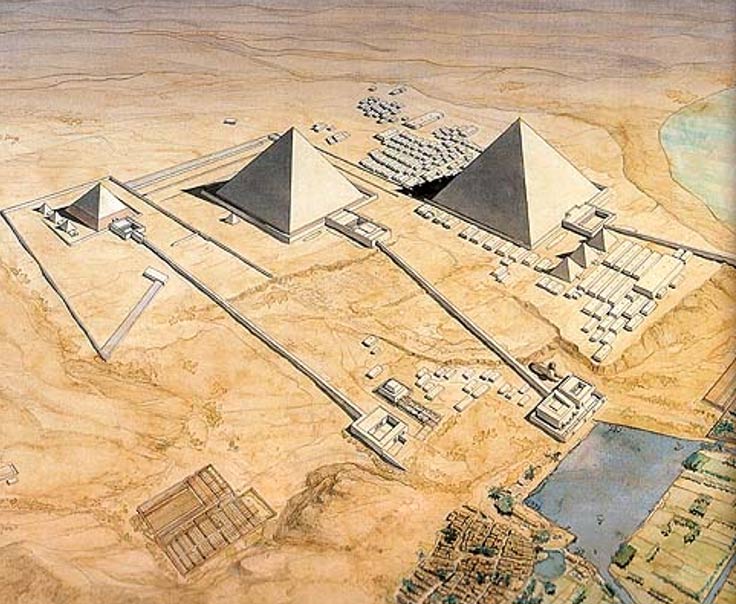
The Minister of Police for Tourism and Antiquities was alerted to the discovery (it’s not clear whether this was by the resident himself). Whatever, security forces immediately placed a cordon around his property.  An archaeologist was placed in charge of a committee to investigate. The committee’s report confirms the finding of the corridor leading to the Great Pyramid, the oldest and largest of the three pyramids in Giza.  It’s thought these causeways were covered corridors or passages linking each pyramid to its temple complex or maybe with the Nile.

How exciting!  I love it when new discoveries are made in Egypt.  As a writer of fiction, it’s a never-ending source of inspiration.

What became of the resident beneath whose home the causeway was found is not clear.  Perhaps I can somehow weave him into a story !

Fiona Deal

Author of Meredith Pink’s Adventures in Egypt

BookCoverPreview.doBookCoverPreview.doHatshepsut's_Hideawa_Cover_for_KindleBookCoverPreview.doBookCoverPreview.doBookCoverPreview.do


My top 10 historical sites in Egypt

I’ve visited Egypt 11 times in total, since falling in love with it on my first visit with my parents in 1983.  Now I write a fictional adventure / mystery series set there : Meredith Pink’s Adventures in Egypt.  There are six books in the series so far.  Each is a modern adventure with an ancient Egyptian mystery at its heart.

As a frequent visitor to Egypt, I thought it would be fun to compile a list of my favourite places to visit.  This list is my personal top 10, so feel free to disagree with me. I think I’ll do it as a countdown …

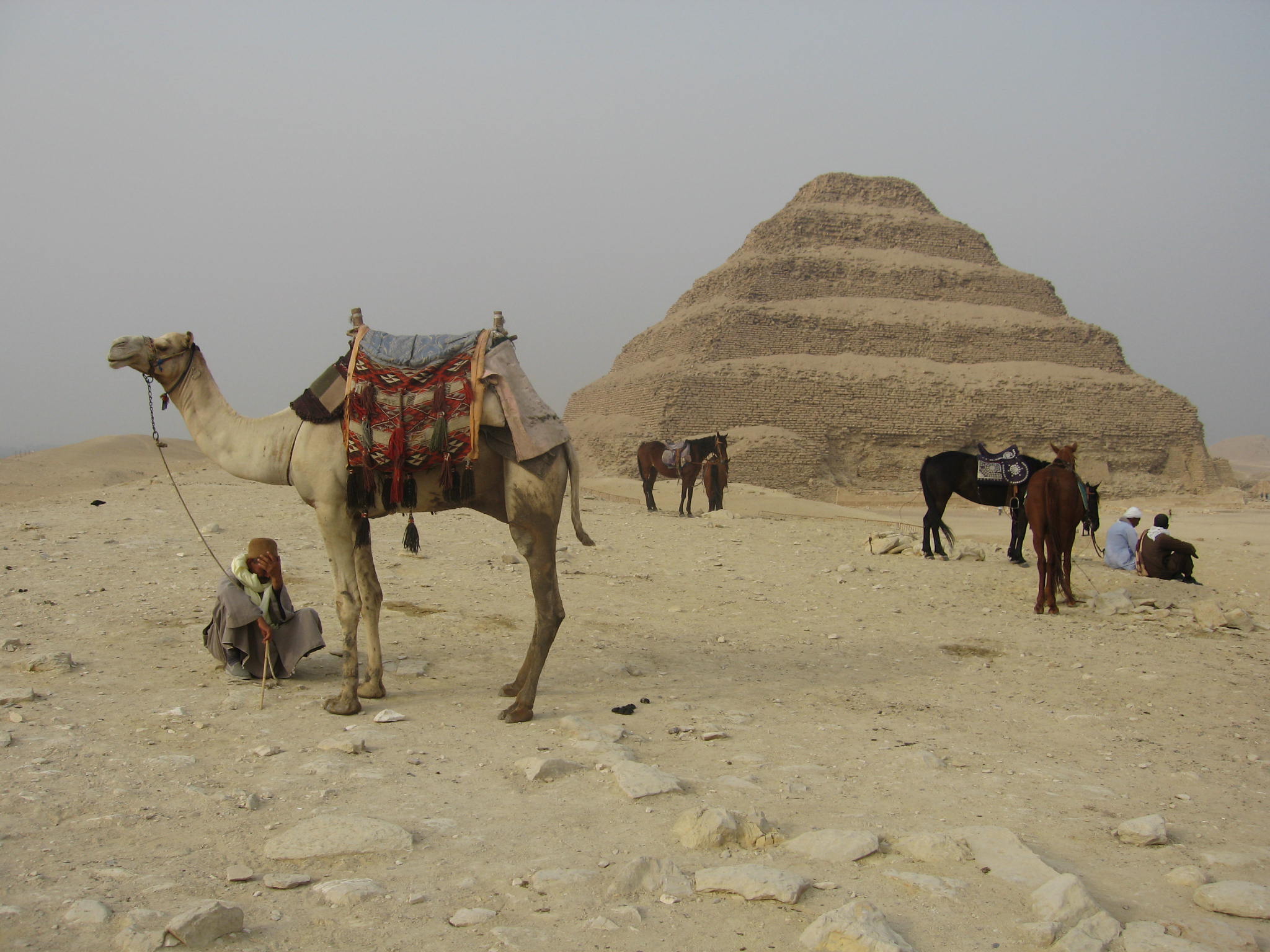
IMG_4517So, in at number 10. The stepped pyramid at Sakkara (or Saqqara as it’s sometimes spelled). My lead characters Merry and Adam take a trip to see the stepped pyramid in my first book Carter’s Conundrums. II was last at Sakkara in 2008.

IMG_4625


At number 9, the Temple of Edfu, probably the best preserved of all the ancient Egyptian temples. It dates from the Graeco-Roman period, and is included on any Nile cruise itinerary. It’s the location of a scene in Hatshepsut’s Hideaway, the third book in my series.

Here I am outside the main pylon – March 2008.


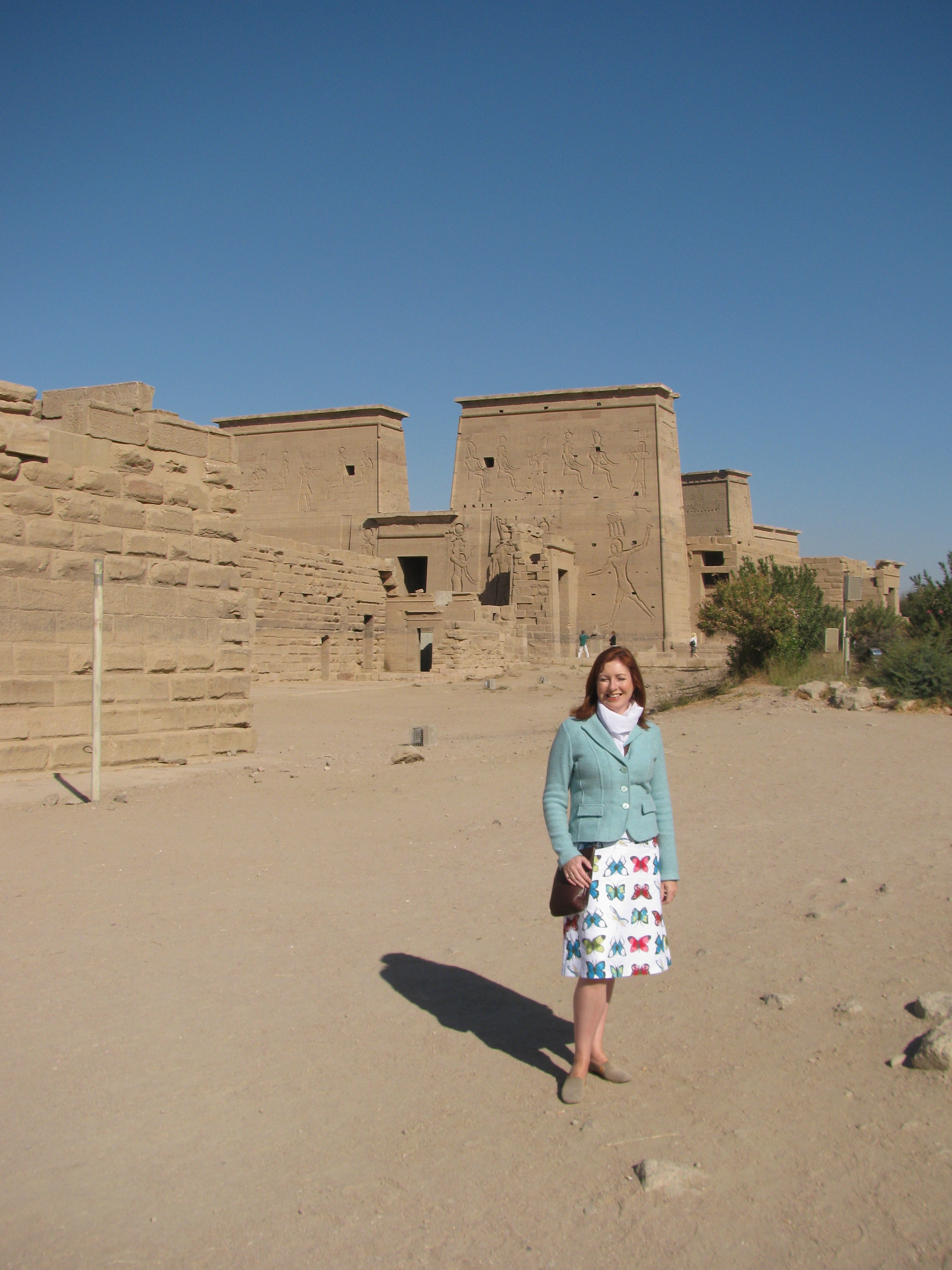
IMG_4215At number 8, the Temple of Philae, near Aswan. It’s a lovely temple, also dating from the Graeco-Roman period, and dedicated to the goddess Isis. It was rescued by UNESCO as after the British dam was built in the early twentieth century it spent half the year under water. UNESCO moved it piece by piece to the nearby island of Agilika. Not yet used as a location in my books. Here I am in January 2012.


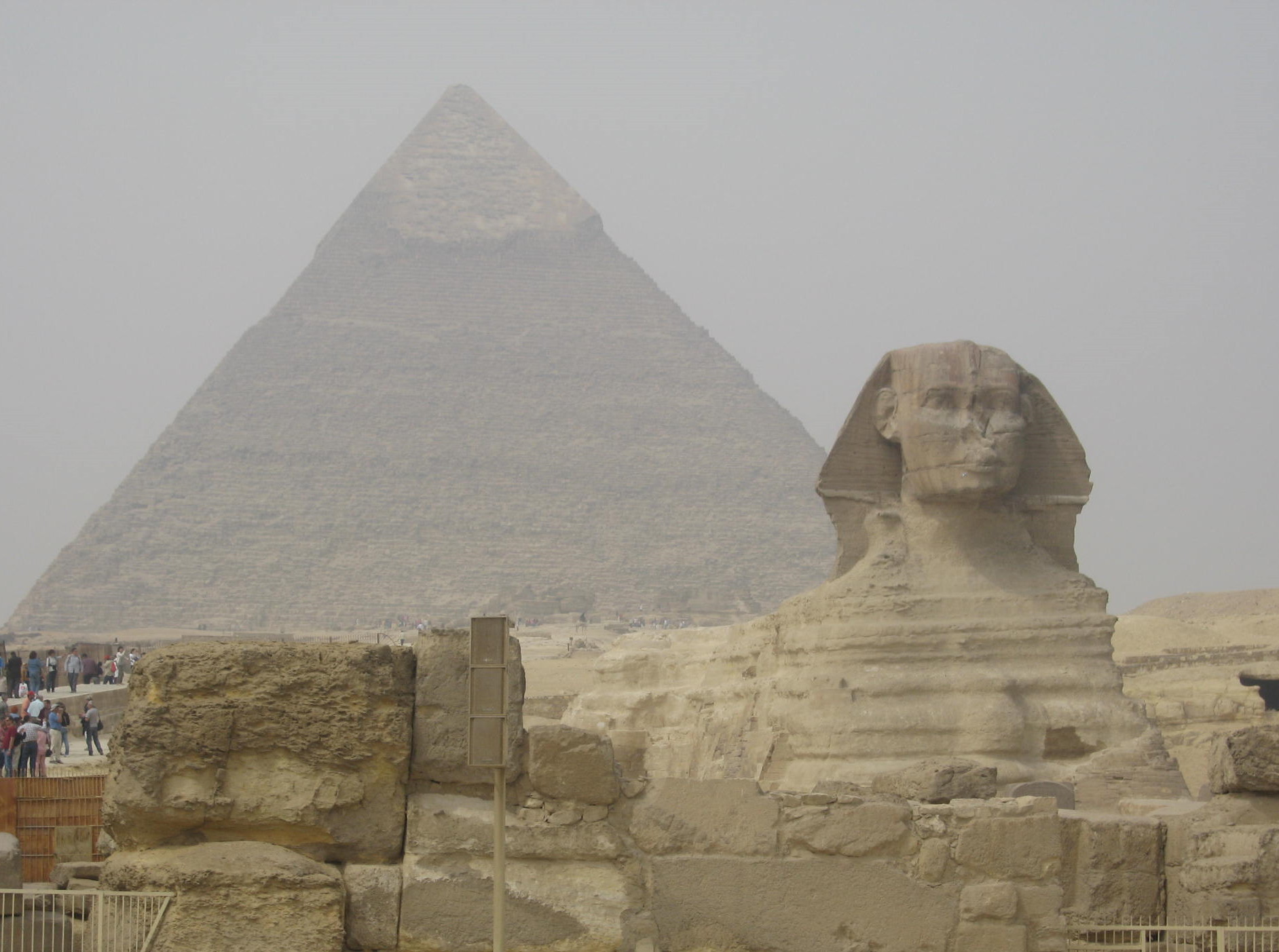
IMG_4505Number 7 is the pyramid and sphinx (not sure if it’s cheating to put them together) on the Giza plateau in Cairo. The pyramids tower over the surrounding suburbia. Merry sits near the swimming pool in Le Meridien hotel, gazing in awe at the pyramids in my second book Tutankhamun’s Triumph.

IMG_0825


At number 6, I’ll go for the Temple of Medinet Habu, built by Ramses III and located on the West Bank at Luxor. It’s not always included in the touring itineraries, but well worth an independent visit. The original colours are beautifully preserved.

Not yet used as a location in my books.


scan0108


At number 5, The Valley of the Kings. A barren, desolate and rather forbidding place … once stuffed with enough gold to sink a battle ship, buried in the tombs of the dead pharaohs. It’s forbidden to take photographs nowadays – so here’s one of me taken back in 2004. The Valley of the Kings features prominently in all of my novels.


scan0141Number 4, the wonderful Winter Palace hotel. I was lucky enough to stay here for New Year in 2008-9; the best New Year’s Eve ever! Frequented by both Howard Carter and Lord Carnarvon in the years leading up to the 1922 discovery of Tutankhamun.

Once used literally as a palace for King Fuad and King Farouk I used it as a location in both Carter’s Conundrums and Farouk’s Fancies.


DSCN5281So, to my personal top 3.

At number 3 I think it has to be Hatshepsut’s Temple on the West Bank in Luxor. It features prominently in all six books. Set dramatically against the craggy cliff face at Deir el Bahri, and backed by the Valley of the Kings, it’s rich with dramatic potential.

IMG_2940


At number 2, the complex of temples that make up Karnak. The Hypostyle Hall takes my breath away every time I go there. The temple is the largest religious structure ever built. Words are inadequate to the task of describing it. As yet, I’ve perhaps not made as much of its dramatic potential as I could.  Merry and Adam go there to look at the obelisks in Carter’s Conundrums.


IMG_4480


So, we’ve arrived at number 1. Personally, for sheer egotistical magnificence, I don’t think you can beat the temples of Abu Simbel, built by Ramses II. Yes, I’m cheating again. There are actually two temples… one for Ramses himself, and a smaller one for his great royal wife Nefertari. I walked around the latter with a lump in my throat – it’s exquisite. They’re also a marvel of modern engineering, raised to higher ground by UNESCO to escape the rising waters of Lake Nasser.

IMG_4482

So, there you have it. My personal top 10. I’ve not mentioned Luxor Temple, the Ramesseum, Denderah, Abydos – all equally awe-inspiring. … Great! Another reason to go back and loads more opportunities for book settings ! I guess maybe I should have done a top 20!

Fiona Deal

Author of Meredith Pink’s Adventures in Egypt, available to download or in paperback on Amazon.

BookCoverPreview.doBookCoverPreview.doHatshepsut's_Hideawa_Cover_for_KindleBookCoverPreview.doBookCoverPreview.doBookCoverPreview.do


A good time to visit Egypt as a tourist?

Fiona Deal's avatarFiona Deal

In view of the tragedy that unfolded in Paris yesterday, I thought it was a good time to brush the dust of this, one of my first posts about Egypt.  The Foreign Office is advising visitors to Paris to exercise extra care.  It just goes to show you can be anywhere in the world when terrorism or tragedy strikes.  Just look at the Boston marathon a couple of years back, the Mumbai and London bombings, etc.

Egypt is a nation that has experienced perhaps more than its fair share of upheaval – much of it political in recent years.  The Foreign Office still advises against all but essential travel to certain parts of the country (not including the prime tourist locations around the Red Sea and in Cairo and Luxor.  So, should tourists continue to stay away?

As someone who has visited Egypt almost every year for more than a…

View original post 627 more words

A frequent visitor to Egypt

BookCoverPreview.do

I’ve been asked recently if I live in Egypt as that’s where my fictional series following Meredith Pink’s Adventures is set.  I don’t.  But I’ve been a frequent visitor over the years.

I feel a strong sense of belonging, which is perhaps the next best thing to calling somewhere ‘home’.

IMG_4744My most recent trip was in July 2014, staying at the lovely Jolie Ville hotel, on its own island just outside Luxor.  This was my third trip to the Jolie Ville, which features as a location in the first three books in the series: Carter’s Conundrums, Tutankhamun’s Triumph and Hatshepsut’s Hideaway.  I also stayed there in 2011 (a few weeks after the Revolution) and 2009.  Tourism has been hit hard by the political upheaval of recent years.  In July 2014, I was one of only 24 guests at the hotel, which caters for something like 1,600.  Great for private use of the pool, but not for the staff who work so diligently to give guests a memorable stay. It’s tragic to see it like this, and I urge visitors to return.  I’ve always felt completely safe.

It’s fair to say in the last decade, I’ve been to Egypt almost every year; sometimes cruising the Nile, sometimes touring, and sometimes staying in either Luxor or Cairo.  To my way of looking at it, Egypt has everything: guaranteed sunshine and warmth, friendly people, great food and fascinating places to visit.  If you’re interested in ancient history or archaeology, so much the better.  Egypt is a place to capture the imagination and the heart.  I was hooked from my very first trip back in the mid-eighties when my parents took my brother and me for a half-term break one October.  We split our time between Cairo and Luxor and I remember I came home with my head spinning.

Now I write adventure/mystery stories based in Egypt.  So even when I’m unable to be there for real, I can travel there inside my head.  I hope the books enable my readers to experience the land I love so much too.

Fiona

Author of Meredith Pink’s Adventures in Egypt – ancient mysteries wrapped up in modern adventures.

BookCoverPreview.doBookCoverPreview.doHatshepsut's_Hideawa_Cover_for_KindleBookCoverPreview.doBookCoverPreview.doBookCoverPreview.do


What lies beneath …?

Photo by Paolo Bondielli Min Project – Luxor Times

Published in the Luxor Times on 1 January, the first discovery in Egypt of 2015.  Found in Qurna, on the Nile close to Luxor, this is an Osirieon, a kind of God’s tomb, dedicated to Osiris.  It just goes to show how much still lies buried beneath the sands of Egypt, awaiting discovery.

As a fiction writer of an adventure/mystery series set in present-day Egypt, these continued discoveries are beyond thrilling.  My characters have been lucky enough to make a few discoveries of their own.  Some might say their ‘finds’ are far-fetched, and they’d probably be right.  My characters are not archaeologists or excavators.  Meredith (Merry) Pink starts her adventures in Egypt as a simple holidaymaker.  She counts herself fortunate when she meets a would-be Egyptologist who then introduces her to a professor who is the real thing, and can help her out with what she’s found.

BookCoverPreview.do

Carter’s Conundrums is Merry’s first adventure.  It’s the story of an accidental discovery that sheds new light on Howard Carter’s discovery of Tutankhamun’s tomb.  And it poses a few questions about what else he might have found that the world wasn’t told about at the time…      Writing it, I gave myself the imaginary holiday of a lifetime!  I hope it does the same for my readers.

There are a further five books so far in the series.  In each one Merry plays a part in unlocking a secret from Egypt’s ancient past.  The series is a joy to write and all the time new discoveries are coming to light, I know there will be plenty more ancient Egyptian mysteries for Merry to explore.

All six books in the series following Meredith Pink’s Adventures in Egypt are available to download or in paperback on Amazon.

Fiona Deal

BookCoverPreview.doBookCoverPreview.doHatshepsut's_Hideawa_Cover_for_Kindle BookCoverPreview.doBookCoverPreview.doBookCoverPreview.do


Exodus: Gods and Kings (Part 2)

imagesRidley Scott’s motion picture Exodus: Gods and Kings is in cinemas now.  It has sparked a storm of controversy in some Middle Eastern countries, where many have banned it for both historical and religious inaccuracies.  I wrote a blog a couple of days ago looking at the historical side of the Exodus story, specifically whether there is any evidence that Pharaoh Ramses II was the Pharaoh of the Oppression / Exodus as depicted in popular culture.

It is problematic to write an opinion-piece about religious inaccuracies for fear of causing offence.  There has always been debate about the extent to which the Old Testament and other religious books, such as the Torah, are historical or literary works.  As such, I guess the question is whether they should be taken literally or whether some poetic licence is allowable.  I daresay even the most ardent Biblical scholar would accept the Old Testament stories were handed down orally through generations before they were written down.  So some embellishment and distortion is likely, which is perhaps how all the best myths grow up in the popular imagination.

So to call something inaccurate religiously-speaking, one would have to take the Bible stories at face value and expect them to be faithfully retold without deviation or dramatic licence.  Perhaps that’s a bit much to ask of a movie-maker.

To my way of looking at it, the Bible and other religious works are books of faith.  I personally don’t consider faith is at odds with having an enquiring mind.  I don’t see how seeking the historical genesis (no pun intended) of the Bible stories undermines any theological beliefs we may hold.  Put simply, whether or not I believe in Adam and Eve in the Garden of Eden as a ‘historical’ event or as a parable to reference good and evil and the consequences of our choices and actions…  it makes no difference to the ‘faith’ I may have in a higher being, whom we might call God.

BookCoverPreview.doAnd so, I turn to the Exodus story and feel free to ask questions and form opinions as, I suspect, did Ridley Scott and Cecil B DeMille and other film-makers.  I do so because I am a fiction-writer.  My latest novel, Seti’s Secret (Book 6 in a series following Meredith Pink’s Adventures in Egypt) also explores the Exodus story, although from a different angle.  Wouldn’t it be wonderful if something could be found in Egypt to cast light on the Exodus from the historical / archaeological perspective?

The ten plagues of Egypt and the parting of the Red Sea by Moses are apocryphal.  We can choose to see the hand of God at play or we can seek an explanation in the natural world.  Much has been written about the possibility of a series of ecological disasters causing the plagues.  The volcanic explosion of Santorini in antiquity is also cited as possibly being linked to both the plagues and the parting of the Red Sea.  But was it the Red Sea?  The literal translation of Yam Suph is ‘Sea of Reeds’.  This might make a more likely location for the crossing of the fleeing Israelites in bitter lakes near the Delta region, not far from Suez (perhaps not quite so exciting for the special effects team of a movie-maker).

Morocco halted screenings of Ridley Scott’s epic because the film contains a “representation of God”, which is forbidden under Islamic Law.  Scott depicts the vengeful God of the Old Testament as a young boy who comes across as a bloodthirsty little chap, for all his public schoolboy way of speaking.

This vengeful God has always seemed to me somewhat at odds with the author of the Ten Commandments.  But then, as others have pointed out, these appear to be a re-phrasing of Spell 125 of ancient Egyptian Book of The Dead.

Similarly, Psalm 104 is a virtual mirror image of ‘the heretic’ Pharaoh Akhenaten’s Hymn to the Aten.  So to my way of looking at it, and at the risk of offending those of a more orthodox religious view, the origins of many of the world’s leading religions today can be found in ancient Egypt.

Moses is credited as being the father of Judaism and forefather of Christianity and Islam.  Many writers and historians have sought out the identity of Biblical Moses among the royal families of ancient Egypt.  The Bible makes it clear he grew up in the royal household.  Sigmund Freud, the Jewish father of psychoanalysis, was the first to suggest a link between the apparently monotheistic beliefs of the pharaoh Akhenaten and the great monotheistic religions of the world today.  In his book Moses and Monotheism, published in English in 1939, he suggested Moses may have been a follower of Akhenaten, and perhaps served at his court.  This seems to me an inherently more likely scenario than growing up as a ‘brother’ of Ramses II, and helps explain so much more …

BookCoverPreview.doIf you’re interested in finding out more, and you like a relatively light escapist read, you might want to give my fictional series a try. The Moses story is explored in Akhenaten’s Alibi and Seti’s Secret.

BookCoverPreview.doThe series starts with Carter’s Conundrums.  All six books in the series are set in present-day Egypt.  Each is a modern adventure that also sets out to explore an ancient mystery.  They are available to download or in paperback on all Amazon sites.

Happy New Year to all.

Fiona Deal

Author of Meredith Pink’s Adventures in Egypt


Exodus: Gods and Kings

BookCoverPreview.doMy latest novel in the series following Meredith Pink’s Adventures in Egypt is called Seti’s Secret.  It is an adventure story set in modern-day Egypt but, as with the previous five novels in the series, it sets out to explore an ancient mystery.  For this book, I have chosen the Exodus story, proposing the historical identities of the Pharaoh as well as of Moses himself.

Publication of my book has coincided with Ridley Scott’s release of his Biblical film epic Exodus: Gods and Kings.  I went to see the film yesterday, interested to compare my take on ‘The Greatest Story Ever Told’ with Scott’s.

Since its release on Boxing Day, the movie has been banned in Egypt, Morocco and the UAE.  Egypt cites historical inaccuracies in the film, including depictions of the Jews building the pyramids and an earthquake causing the parting of the Red Sea.  Morocco has halted screenings because the film contains a “representation of God”, which is forbidden under Islamic Law.  The UAE has supported its decision saying the film contains religious inaccuracies about Islam as well as other religions, although it has not specified these inaccuracies.

I guess the movie-going public is arguably less concerned about historical and religious accuracy than it is about enjoyment.  I won’t comment on whether or not the film is enjoyable – that is for each person who sees it to decide.  I certainly found it epic, with sweeping vistas and grand stage sets – the plagues were particularly well depicted.  But as a writer, accuracy is something I have to be concerned with, and there are a few points I’d like to explore.

The opening title sequence tells us it is 1300 BCE (Before ‘Christian’ or ‘Common’ Era).  This places us in the latter years of the reign of Pharaoh Seti I, who appears briefly in the early scenes of the film as the elderly king about to pass on his throne. To be fair to Ridley Scott, I’m not sure he represented the Hebrew slaves as building THE pyramids.  True, the film shows workers constructing pyramids (in the sweeping panoramic shots of ancient Memphis) but I expect this is just for dramatic effect.  The Giza pyramids were built some 1000 years earlier during the Old Kingdom, presumably long before the Israelite sojourn in Egypt as described in the Bible; and before the 400 years Scott’s opening titles claim the Hebrews have been enslaved.  I guess it depends whether you’re prepared to accept that pyramids continued to be built in Egypt, even into the New Kingdom.

A more interesting historical inaccuracy for me was the scene showing Seti I’s funeral taking place at the Temple of Abu Simbel – another piece of grand cinematography – but factually impossible, since Abu Simbel wasn’t built at the time, and Seti I was interred in the Valley of the Kings.

If the film showed an earthquake parting the Red Sea, I missed it.  I saw Moses go to sleep asking for divine intervention, then wake to find the waters had miraculously drained away to allow the Hebrews to cross.  The special effects showing the seawater crashing back in again are among the most impressive in the film – although it is perhaps stretching credulity to the limit for both Moses and Ramses to survive the deluge, on their opposite banks of the Sea, given the on-screen violence of the Tsunami-like wave that engulfs the Egyptian army and both lead characters with it.

The Bible is oblique about whether or not the Pharaoh survives being cast into the sea.  The Torah is more specific in suggesting the Pharaoh drowns.

Which brings me to what I consider the crux of the historical matter.   Was Ramses II (Ramses the Great) the Pharaoh of the Exodus?  Ridley Scott apparently believes so, as did Cecil B DeMille before him, in his film The Ten Commandments.  Yet is there any historical evidence for his candidacy?

Ramses II ruled Egypt for upwards of sixty years.  His mummy is on display in the Egyptian Museum in Cairo and is of a man in his nineties when he died.  So if he pursued the fleeing Israelites into the Red Sea he certainly survived it.

Interestingly, the Bible never names a Pharaoh.  So we are forced to look for other evidence in the Old Testament as well as in the historical and archaeological record to identify which Pharaoh is described.

The primary argument in support of Ramses II in the Exodus story seems to be that the Bible states the Pharaoh subjected the Hebrews to harsh labour building his store cities of Pithom (the location used in Scott’s film) and Ram’ses.  Ramses II certainly built a new capital city Pi-Ramses (or Piramesse).  Its remains have been discovered under the modern town of Qantir in the Eastern Delta, close to a branch of the Nile that silted up approximately 1,000 BCE.  Because Ramses built a city and named it for himself, hey presto he is the Pharaoh of the Biblical Exodus story.  That’s it.  That’s the evidence.

What is perhaps not so well known in popular culture is that Pi-Ramses was apparently built on top of the remains of an earlier city.  Historians have identified this as the Hyksos capital of Avaris and perhaps also the border city of Zarw, identified by some as Biblical Goshen, where the Hebrew tribes are said to have settled after their descent into Egypt.

If true, this enables us to construct a rather different scenario.  The historical record tells us that the grandfather of Ramses II, who ruled as Ramses I, was the Overseer of the Fortress of Zarw while still a commander in the previous Pharaoh’s army.  As he shares the name of his more famous grandson, I think it equally possible that he was the one who oversaw the daily lives of the Hebrews living in the place his grandson later decided on as the location for his new city.

The Bible also suggests the Pharaoh of the Exodus was not the same individual as the Pharaoh of the Oppression.  Exodus 3:6 describes Moses’ reluctance to return the Egypt to free the enslaved Hebrews after God speaks to him from the burning bush.  God reassures Moses that his life will not be in danger if he returns to Egypt as “all those who wished to kill you are dead”.  The earlier section (Exodus 1:8) tells us “Now there arose up a new king over Egypt”.  These passages suggest that during the years Moses spends in the wilderness, the previous pharaoh has died to be replaced by a new one. This would exclude Ramses II as being the Pharaoh to banish Moses and also the one on whom Moses unleashes the ten plagues.

There is more evidence, of course.  But, for now, I’ll end by saying if you’re interested in how the historical and archaeological evidence can be used to construct an alternative set of characters for the Exodus story, you may wish to read Seti’s Secret. (This is book 6 in a series, so I’d suggest you start with the first book Carter’s Conundrums).  The books are available on all Amazon sites.

As for the religious inaccuracies cited by the nations who have banned Ridley Scott’s film, I’ve decided they are the subject of a whole new article, which I will publish in the next couple of days.

Fiona Deal

Author of Meredith Pink’s Adventures in Egypt

Tutankhamun: The Truth Uncovered

Last night I watched the hour long BBC1 documentary called ‘Tutankhamun : The Truth Uncovered’.

It set out to present clues as to why the most famous Egyptian Pharaoh of them all died so young.  The theory of murder due to a blow to the head was debunked.  Actually, it was debunked years ago … the bone fragments shown by X-ray to be floating in the back of the boy king’s skull were proved to have been displaced post mortem and also after the embalming process.

The programme showed us a ‘virtual autopsy’ using more that 2,000 CT scans of Tutankhamun’s mummified body.  This remarkable technology has enabled scientists to reveal the first ever full-sized, scientifically accurate computer generated image of the young king.  Sadly, it is a far cry from the hauntingly beautiful and perfect image we are more used to from the glorious death mask and much of the other artwork and statuary surviving of Tut from antiquity.

It reveals the club foot, which explains once and for all why so many walking canes – over 120 of them – were found by Howard Carter when he entered Tutankhamun’s tomb. I can’t help but wonder if seeing ‘the truth uncovered’ might actually be a little less than Tutankhamun deserves.  We come face to face with a teenager who might now unkindly, but no doubt accurately, be referred to as a cripple.  I’m sure he’d have preferred the images of himself riding his chariot, full of youthful vigour to be the ones to survive him down the centuries.

And with mention of the chariot (there were six of them found dis-assembled in Tutankhamun’s tomb) we come to the next popular theory explaining his early death. The CT scan reveals the fracture above his knee, which experts believe to have killed him.  A long-held theory is that the fracture was caused by a fall from his chariot whilst out hunting, or perhaps even in battle. (Or maybe he was pushed?).  But last night’s documentary suggests it would have been almost impossible for the young king to ride at any speed in a one-man chariot.  Or indeed ride a chariot at all.  The club foot and bone wasting disease shown also to be affecting his left foot would, we are told, have made it excruciatingly painful to ride.

And so, another explanation has to be found.  It is not slow in coming.  Epilepsy.

This condition, we are told, may also account for the ‘visions’ experienced by Tutankhamun’s predecessors.  His great-grandfather, Thutmosis IV, recorded in the famous ‘dream stele’ (still situated between the paws of the Sphinx) the vision in which the Sphinx spoke to him and told him if Thutmosis cleared the sand from around the Sphinx’s body, he would be crowned king.  And, Akhenaten, the controversial pharaoh who preceded Tutankhamun was apparently given to religious visions, which led him to elevate the sun disc, the Aten, as the sole god from the Egyptian Pantheon.  They also led him to build a new city, modern Amarna, on virgin soil in middle Egypt.

And now, with the mention of Akhenaten, we come to the part where I take issue with last night’s documentary.  DNA testing has enabled scientists and Egyptologists to build Tutankhamun’s family tree.  This has established that the body found in tomb KV55 is Tut’s father, and the ‘younger lady’ found in the cache hidden inside Amenhotep II’s tomb is Tut’s mother.  More astonishing, Tutankhamun is shown to be the product of an incestuous full-brother-and-sister relationship.

This much, I believe, is irrefutable.  It seems to me tragic that in their attempts to keep the royal bloodline pure, the pharaohs of the late 18th dynasty actually inbred its genetic downfall.

BUT, the documentary makes one big and, to my way of looking at it, unsupportable assumption … That the KV55 mummy is Akhenaten.  Ergo Akhenaten is Tutankhamun’s father.  This is presented as FACT, with no questions asked.

This does the viewing public a huge disservice.  While Akhenaten is unquestionably one candidate as the KV55 mummy, he is not the only one.  Many scholars believe the skeleton to be that of Akhenaten’s younger brother, an ephemeral character on the pharaonic stage.  His name was Smenkhkare.  Nobody has ever been able to prove the identity of the KV55 mummy for sure.  So, for the BBC to overlook this and present Akhenaten as the sole candidate seems to me to be misleading and negligent.

We know Akhenaten was famously married to Nefertiti.  They very publicly had six daughters.  Images of the whole family are plastered all over Amarna.  Nobody has yet gone so far as to suggest the ‘younger lady’ is Nefertiti, or that she was Akhenaten’s full sister.  So, we must suppose that Akhenaten had an incestuous relationship with one of his full sisters, who bore Tutankhamun.  Under the royal protocol of the time, she would have had to be one of his wives, possibly even his Great Royal Wife.  For this to have completely escaped the historical record seems to me extremely unlikely.

Yet, if his younger brother Smenkhkare were to have had an incestuous marriage with one of their sisters, with Tutankhamun as the result, it seems perfectly possible for no record of it to have survived.

I personally believe Smenkhkare is the KV55 mummy.  Other scholars agree.  One other piece of evidence supports this theory.  On last night’s documentary, Tutankhamun was repeatedly described as Akhenaten’s successor.  He wasn’t. At least, not at first.  The historical record shows quite clearly that Smenkhkare came to the throne on Akhenaten’s death.  Incidentally, Smenkhkare married Akhenaten & Nefertiti’s eldest daughter, his niece Meritaten, presumably to strengthen his right to rule.  She became his Great Royal Wife.  Whether his previous sister-wife was still alive at the time is a matter for conjecture.

It is not clear how long Smenkhkare ruled.  Some experts say a few months, others up to three years.  But rule he did.

To me, this is more evidence that Tutankhamun was not Akhenaten’s son.  There are plenty of other examples of minors coming to the throne, so his age would not have presented a reason for him to be passed over in favour of his ‘uncle’ Smenkhkare if indeed Akhenaten was his father.  I think in the absence of a male heir who was his son, the throne passed to Akhenaten’s brother and only then on Smenkhare’s death to his son, Tutankhamun.

Frustratingly, none of this can be proved once and for all.  We need more discoveries to be made in the historical record, or for modern science to take yet another leap forward.

I’m left with the impression of a documentary wanting to re-work old ‘truths’ to find a new angle.  I’d have been perfectly happy with this, if only certain assumptions were not presented as fact.

Luckily for me, there is one field in which it’s more acceptable to work within what’s known, and make up the rest.  I am a fiction writer.  The mysteries of ancient Egypt are my chosen subject.  So last night’s documentary was of particular interest.  I’m pleased to say, it didn’t present anything to make me go back and rewrite any of the content of my books.  The second book in my series following Meredith Pink’s Adventures in Egypt is Tutankhamun’s Triumph.  If you’re interested in reading more about Tut’s family tree, you may wish to give it a go.

Fiona Deal

Author of Carter’s Conundrums, Tutankhamun’s Triumph, Hatshepsut’s Hideaway, Farouk’s Fancies and Akhenaten’s Alibi. Available on Amazon.com, Amazon.co.uk, and all other Amazon sites.
BookCoverPreview.do


Book 2 of Meredith Pink's adventures in Egypt

Book 2 of Meredith Pink’s adventures in Egypt
Hatshepsut's_Hideawa_Cover_for_Kindle BookCoverPreview.do

BookCoverPreview.do